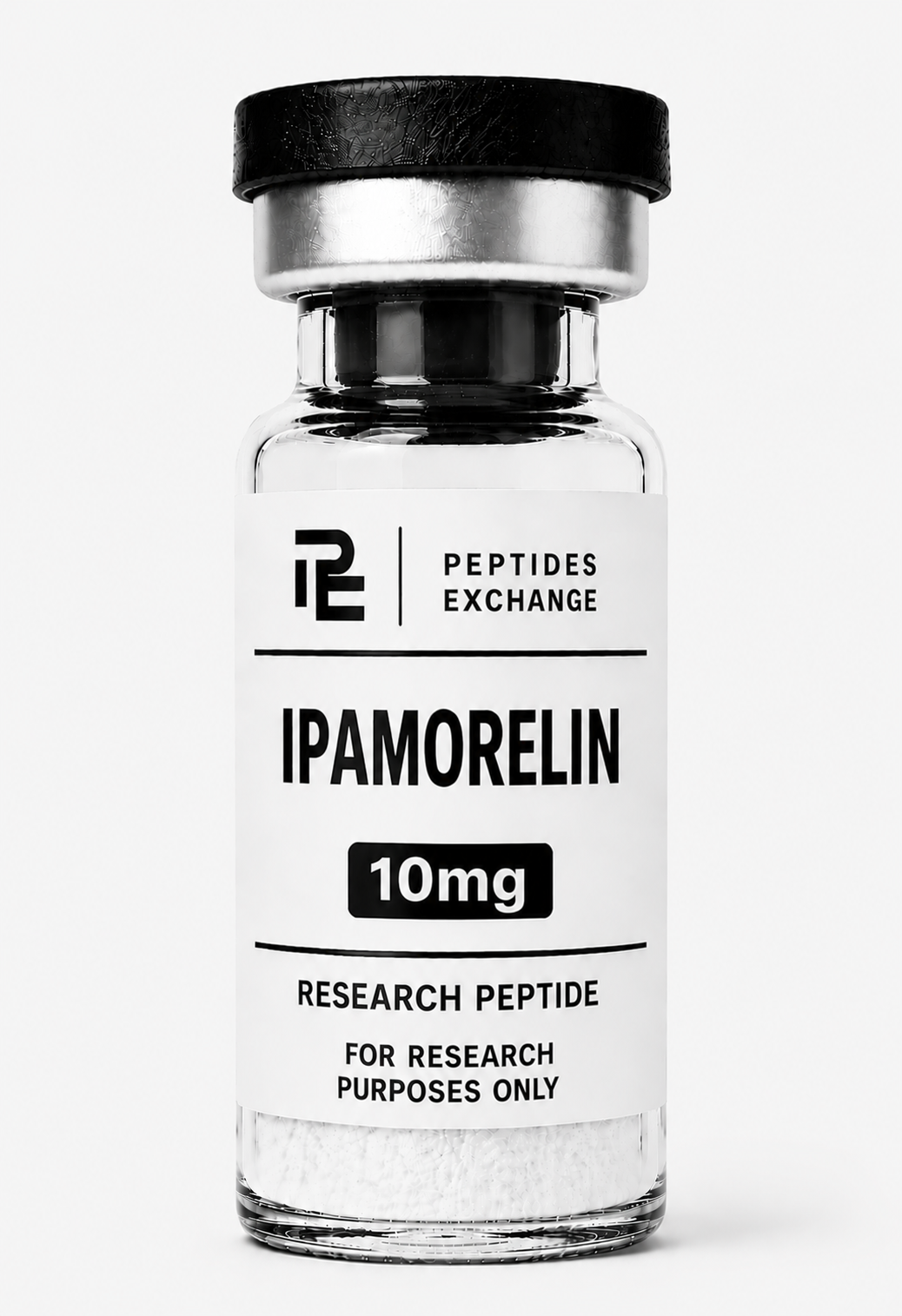

Ipamorelin
Here's the product description:
Ipamorelin Research Peptide
Ipamorelin is a synthetic pentapeptide (Aib-His-D-2-Nal-D-Phe-Lys-NH2) classified as a selective growth hormone secretagogue and ghrelin receptor agonist. Distinguished by its high receptor selectivity relative to earlier generation secretagogue compounds, Ipamorelin has become a widely utilized preclinical research tool for investigating somatotropic axis dynamics, GHSR signaling mechanisms, and growth hormone pulse architecture in controlled non-human laboratory model systems.
Ipamorelin — Mechanism of Action
Ipamorelin exerts its biological activity through selective high-affinity binding to the growth hormone secretagogue receptor (GHSR1a) expressed on anterior pituitary somatotroph cells and hypothalamic neurons. Receptor engagement initiates G-protein coupled signaling cascades involving phospholipase C activation, IP3-mediated calcium mobilization, and protein kinase C pathway stimulation, culminating in pulsatile growth hormone exocytosis from pituitary secretory granules. A defining characteristic of Ipamorelin's preclinical pharmacological profile is its selectivity — unlike earlier secretagogue peptides such as GHRP-2 and GHRP-6, Ipamorelin demonstrates minimal cross-reactivity with receptors governing cortisol, prolactin, and ACTH release at research-relevant concentrations, enabling cleaner isolation of GH secretagogue effects in experimental model systems.
Ipamorelin — Research Background
Raun et al. (1998) conducted foundational characterization of Ipamorelin's receptor selectivity and growth hormone stimulation profile in animal model systems, establishing its distinction from earlier generation secretagogue compounds through comparative receptor binding and in vivo GH response studies. Preclinical pharmacology literature has consistently documented dose-dependent and temporally reproducible GH release patterns following Ipamorelin administration, with no observed evidence of receptor desensitization or downregulation across extended dosing protocols in laboratory animal preparations. Research by Johansen et al. further examined the synergistic interaction between Ipamorelin and endogenous GHRH, demonstrating that co-administration produces additive GH secretion responses exceeding either stimulus independently in vivo. Additional preclinical investigation has explored Ipamorelin activity in bone metabolism models, body composition studies, and hypothalamic feedback regulation research, expanding its utility beyond primary GH secretagogue investigation into broader endocrine axis characterization work.
Ipamorelin — Product Specifications & Storage
Form: Lyophilized powder
Purity: ≥98%, verified by analytical HPLC
Identity Confirmation: Mass spectrometry
Reconstitution: Sterile bacteriostatic water or normal saline recommended; allow equilibration to room temperature prior to use
Storage: −20°C optimal; protected from light and moisture
Post-Reconstitution Stability: 48–72 hours at 4°C; repeated freeze-thaw cycles should be avoided to preserve peptide structural integrity and biological activity
Research Use Only
Ipamorelin is designated exclusively for preclinical and in vitro laboratory research applications. It is not approved for human use, therapeutic administration, or clinical investigation outside of regulated institutional oversight. All research protocols must conform to applicable institutional guidelines, animal care regulations, and biosafety procedures governing the handling of synthetic secretagogue peptide research compounds.
